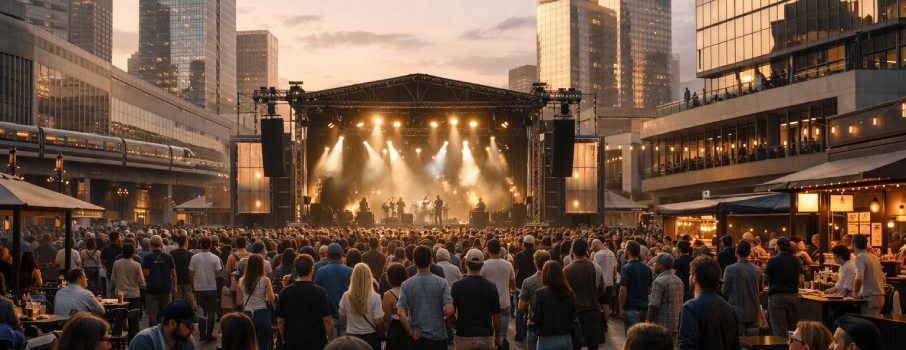
Urban music festivals have been inspired by the urban lifestyle of today, binding people together with a backdrop of cultural, intimating experiences. While travelers make their way to the outside festivals in the hinterland or the beach, the urban festivals stay within the city's routines, thus uniting the local inhabitants and tourists in universality. This has invited an overhaul of lineup scheduling, audience and participants-not to mention, the sort of music that now makes sense in a city.
From Peripheral Events to Central Cultural Fixtures
In earlier decades, large music festivals were often held far from city centers, positioned as temporary escapes from everyday routines. Over time, however, festivals began moving closer to urban cores, responding to changing audience expectations and infrastructure improvements. City-based festivals are easier to access, more inclusive of diverse audiences, and better integrated into local cultural calendars. This shift has turned festivals into recurring civic events rather than isolated spectacles, making them part of how cities define their cultural identity.
Accessibility and Audience Expansion
Urban festivals lower many of the barriers that once limited festival attendance. Public transport, nearby accommodation, and familiar surroundings make it easier for people to attend for a single day or even a few hours. This flexibility attracts audiences who may not identify as traditional festivalgoers, including older listeners, families, and casual music fans. As a result, urban festivals often draw broader demographic mixes, which in turn influences programming choices and the overall tone of the event.
The Role of City Infrastructure
Cities offer built-in advantages for large-scale festivals, from power supply and sound management to crowd control and emergency services. These logistical strengths allow festivals to focus on production quality and artist diversity rather than basic survival concerns. At the same time, urban infrastructure places constraints on noise levels, timing, and spatial design, shaping how festivals are structured and how audiences experience performances within a shared public environment.
Festivals as Urban Storytelling
Urban festivals often reflect the character and values of the cities that host them. Lineups, visual design, and partnerships with local businesses all contribute to a narrative about what the city represents culturally. Rather than existing outside everyday life, these festivals become a form of storytelling that connects music to place. Over time, they help shape how residents and visitors perceive the city itself.
A City-Centered Festival Identity
Unlike festivals set in remote or scenic locations, Electric Avenue positions itself firmly within the urban environment. This choice influences everything from stage layout to audience flow. The city setting reinforces the idea that contemporary music belongs in everyday spaces, not just in designated entertainment zones. It also encourages repeat attendance, as locals can integrate the festival into their regular routines rather than treating it as a once-a-year pilgrimage.
Contemporary Genres and Audience Expectations
Electric Avenue’s focus on current and widely recognized genres reflects the listening habits of modern audiences. Electronic music, pop, hip-hop, and crossover acts dominate urban playlists, and the festival mirrors this reality. This approach acknowledges that many listeners today consume music through streaming platforms, social media clips, and algorithm-driven discovery. The festival experience becomes an extension of those habits, offering a live, collective version of sounds people already engage with daily.
Scale, Production, and Shared Experience
Large audience numbers are central to Electric Avenue’s identity. High-capacity stages, professional-grade sound systems, and synchronized visual elements create an immersive environment that emphasizes scale. For many attendees, the experience of being part of a massive crowd is as important as seeing specific artists. This shared intensity reinforces music as a social experience, where meaning is created collectively rather than individually.
Local and International Balance
While Electric Avenue draws on international acts to anchor its lineup, it also provides space for local artists to perform on prominent stages. This balance helps position New Zealand musicians within global musical conversations while giving audiences a sense of cultural continuity. For local acts, performing in a large urban festival context can signal legitimacy and visibility, contributing to long-term career development.
Urban Festivals and Modern Music Audiences
Over the last twenty years, things have changed, not only in terms of how people engaged with urban festivals of music, but also in relation to how people relate; an individual listener is less tied to just one genre or an artist. They are, instead interested in creating memorable experiences that feel fresh, adaptable, and yet socially meaningful. The world of city-based festivals has much to offer in response to such expectations.
From Loyalty to Exploration
Traditional music fandom often revolved around deep loyalty to specific bands or genres. Contemporary audiences, by contrast, tend to explore widely, sampling music across styles and scenes. Urban festivals support this behavior by offering diverse lineups that encourage movement between stages and genres. Attendees may arrive for one headline act but leave having discovered several new artists, reinforcing festivals as spaces of musical exploration rather than devotion.
The Social Dimension of Listening
Music consumption has become increasingly individualized through headphones and personal devices. Urban festivals counterbalance this trend by restoring music’s social dimension. Being surrounded by thousands of others reacting to the same sounds creates a sense of temporary community. For many attendees, this collective response is what gives live music its emotional power, transforming familiar songs into shared moments.
Visual Culture and Digital Memory
Modern festivals operate within a highly visual and digital environment. Stages are designed to be photographed and filmed, and audiences actively document their experiences. Urban settings amplify this effect, as recognizable cityscapes become part of the visual narrative. These images circulate long after the event, shaping how the festival is remembered and how it attracts future audiences. The live experience is no longer confined to the moment but extended through digital memory.
Expectations of Comfort and Safety
Today’s festival audiences place greater emphasis on comfort, safety, and organization than in the past. Urban festivals are often better equipped to meet these expectations due to existing city services and regulations. Clear transport options, medical access, and crowd management contribute to a sense of security that allows audiences to focus on the music itself. This shift reflects broader cultural expectations around public events and responsibility.
Sound, Space, and the Urban Environment
Urban neighbourhoods change the dynamics of the relationship between sound and space during festivals. As opposed to open fields or out-of-the-way locations, urban lands pose constraints as to public life. These specifications determine how these festivals sound, feel, or operate.
Acoustic Challenges and Solutions
Cities present unique acoustic challenges, from sound reflection off buildings to restrictions designed to protect nearby residents. Urban festivals must adapt through precise speaker placement, volume control, and scheduling. These technical decisions influence how music is experienced, often resulting in cleaner, more focused sound rather than sheer volume. For audiences, this can create a listening experience that feels more controlled and intentional.
Public Space as Cultural Stage
When festivals take place in city spaces, streets and parks are temporarily transformed into cultural stages. This reimagining of public space changes how people perceive their surroundings. Areas associated with work or transit become sites of celebration and creativity. Even after the festival ends, these altered perceptions can linger, subtly reshaping how residents relate to their city.
Negotiating Community Impact
Urban festivals must balance cultural value with community impact. Noise, congestion, and crowd behavior can affect nearby neighborhoods, making community engagement essential. Successful festivals tend to communicate clearly with residents and local authorities, positioning themselves as contributors to city life rather than disruptions. This negotiation reflects a broader understanding of festivals as civic events with shared responsibilities.
Temporal Transformation of the City
For the duration of an urban festival, the city operates on a different rhythm. Normal patterns of movement, work, and leisure are temporarily altered. This temporal shift highlights the city’s capacity for flexibility and collective participation. Festivals like Electric Avenue demonstrate how urban environments can accommodate large-scale cultural expression without permanently changing their structure.
Economic Activity and Local Business
Large festivals generate significant economic activity, particularly in hospitality, transport, and retail sectors. Urban locations allow businesses to benefit directly from increased foot traffic. At the same time, the economic impact is more distributed than in remote festivals, as spending flows through existing city networks. This integration strengthens the case for festivals as contributors to local economies rather than isolated events.
Cultural Visibility and City Branding
Urban festivals often play a role in shaping a city’s external image. Media coverage, artist associations, and audience testimonials contribute to a broader narrative about the city as culturally active and contemporary. For New Zealand cities, events like Electric Avenue help position them within global cultural conversations while retaining local character. This visibility can influence future cultural investment and tourism interest.
Soundtracks of the Modern City
In this way, Electric Avenue is indicative of the central role urban festivals come to play in contemporary music culture. They create an atmosphere in which large-scale sound experiences are integrated into city living and, consequently, they redefine the relationship of the audience with music, space, and each other.